
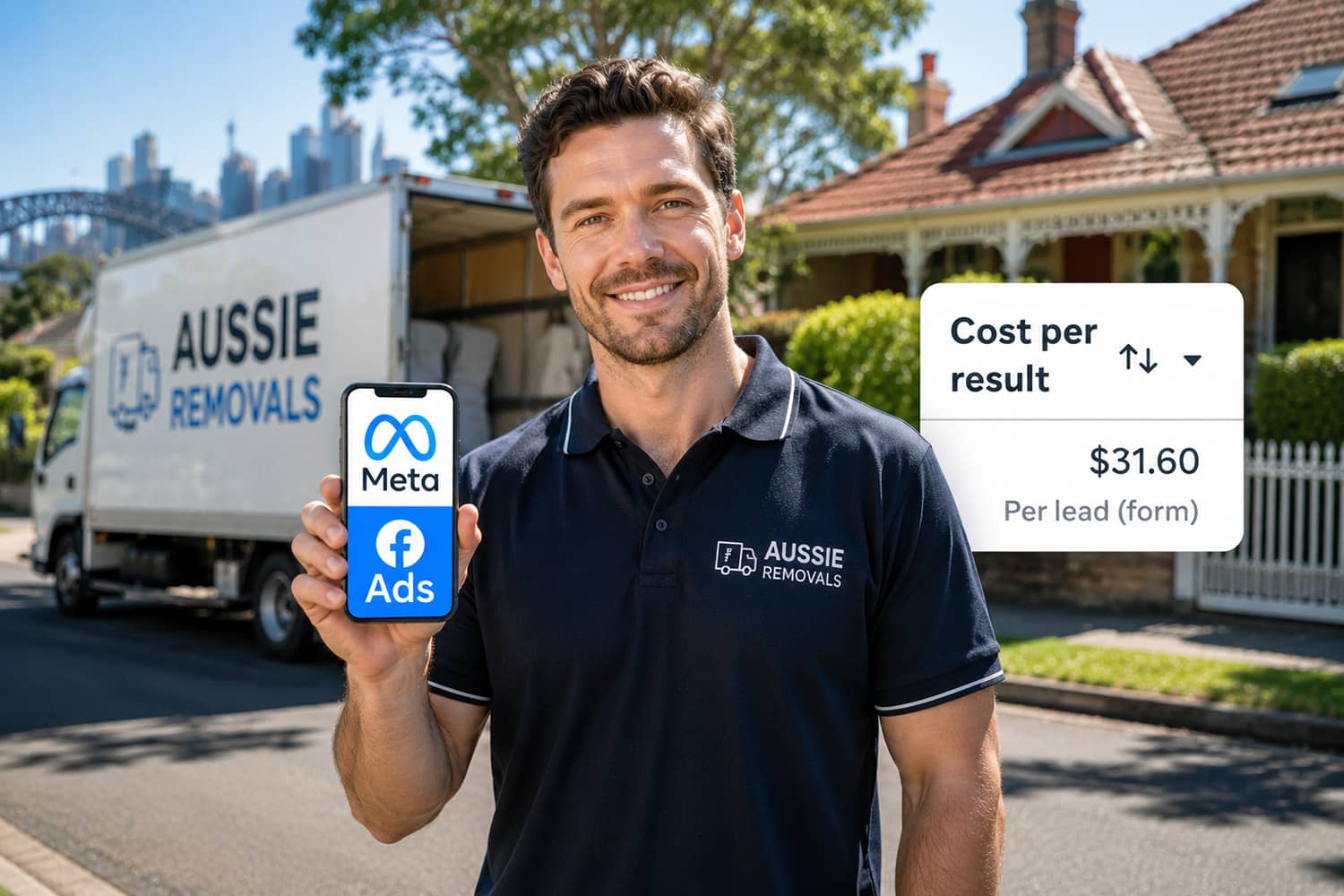
If Google Ads catches the customer at the exact moment they search “removalists near me”, Meta Ads — Facebook and Instagram — catches them weeks earlier, while they’re still scrolling on the couch wondering when to start packing. That’s the entire strategic difference between the two platforms, and it’s why most removalists who try Meta the same way they run Google Ads end up disappointed.
Done properly, Meta is one of the most cost-effective channels a removalist has access to. Done as an afterthought, it’s a quiet money pit that produces likes instead of bookings. This guide walks through how to run Meta Ads in a way that produces actual quote requests — what to advertise, who to target, what creative actually works for movers, and how to know if it’s paying off.
This article is part of our broader complete guide to marketing your removalist business. Read that for the full marketing picture, or stay here for the deep-dive on Meta Ads.
Why Meta works differently to Google (and why that matters)
The single biggest mistake removalists make on Meta is treating it like Google. They write the same ad copy, send people to the same homepage, and wonder why the cost per lead is three times higher. Meta reaches customers at a fundamentally different stage of the buying journey than Google Ads does. If you’re going to spend on both, it pays to understand which stage each one is actually built for. We’ve mapped the full framework in our guide on understanding your customer’s buying journey.
The platforms work on completely different psychology. Google captures active intent — someone has typed “removalists Brisbane” into a search bar, they’re ready to book, and the question is just which removalist they pick. Meta captures passive intent — someone is scrolling Instagram on a Sunday night, your ad appears, and your job is to interrupt them with something compelling enough that they save it, share it, or click through.
That difference shapes everything. On Google, your ad just has to win the comparison shop. On Meta, your ad has to first earn the click in the first place — which means strong creative, clear positioning, and a reason to act now.
The audience size is the other major difference. According to data published by Meta, Facebook and Instagram combined reach more than 21 million Australians monthly — more than 80% of the adult population. For a removalist working a defined service area, that means almost every household in your suburbs is reachable through Meta. The question is just whether you reach them at the right time with the right message.
There’s also a budgeting reality worth being honest about. Research from WordStream puts the average cost per lead for home services on Meta between $25 and $60, depending on the offer, the creative, and the targeting. That’s typically lower than Google Ads for the same category, but with a longer path to a booking — the lead Meta produces often needs more nurturing before it converts.

The four types of Meta campaigns that work for removalists
Meta has a confusing number of campaign objectives. For removalists, only four of them are worth your money.
1. Lead generation campaigns (the workhorse)
The lead form sits inside Facebook or Instagram itself — the user taps your ad, a pre-filled form appears with their name, email, and phone, and they submit without ever leaving the platform. Conversion rates are typically 3 to 5 times higher than sending people to your website, because there’s no friction.
The trade-off is lead quality. Because the form is so easy, people fill it in casually and sometimes forget they did. The fix is a fast follow-up — ideally a phone call within an hour, or an automated SMS within five minutes. Leads that sit untouched for 24 hours go cold fast.
This is the campaign type to start with. It works in almost every service area, the data comes through quickly, and the cost per lead is generally the lowest of any Meta objective for removalists.
2. Conversion campaigns (when your site converts well)
If your website already converts visitors into quote requests at a decent rate — see our guide on building a removalist website that actually converts for what that looks like — a conversion campaign sends Meta-driven traffic directly to your site and optimises for quote form submissions.
This works better than lead-gen forms when your site has strong trust signals, good reviews on display, and an obvious quote request flow. It works worse if your site is slow, cluttered, or asks for too much information upfront. The site is doing half the selling, so it needs to be ready.
3. Retargeting campaigns (the highest ROI campaign you’ll run)
Retargeting shows ads to people who’ve already visited your website but didn’t request a quote. These people already know who you are, so the conversion rate is dramatically higher than cold audiences — typically 3 to 10 times higher.
Almost every removalist should be running retargeting, and most aren’t. The setup is straightforward: install the Meta Pixel on your website, create an audience of people who visited in the last 30 days but didn’t book, and run ads to that audience with social proof, an offer, or a reminder.
Retargeting is also where reviews do some of their heaviest lifting. A retargeting ad that says “Over 400 five-star Google reviews — get a fast quote today” outperforms a generic ad on the same audience almost every time. Our guide to getting more Google reviews for your removalist business covers how to build the review wall that makes retargeting work this well.
4. Brand awareness campaigns (only when you’re established)
Brand awareness campaigns optimise for impressions and reach, not clicks or leads. They make sense for established removalists who want to dominate top-of-mind awareness in a specific service area — but they’re easy to waste money on if you’re not careful.
If you’re newer, skip this and put the budget into lead-gen and retargeting. If you’re established and want to own your service area, brand awareness ads in your top suburbs build the kind of name recognition that improves the conversion rate of every other channel you run.
Who to target (and who to skip)
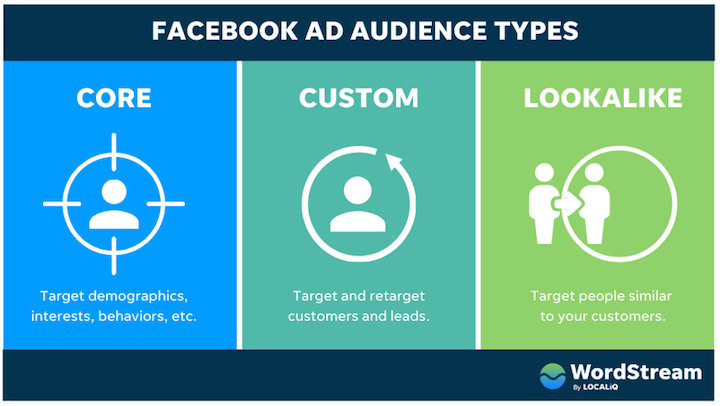
Meta’s targeting is its real superpower. Unlike Google, where you bid on what people search, Meta lets you target based on who people are, where they live, and what’s happening in their life. For removalists, three audience categories matter most.
Geographic targeting
Start with a tight radius — your actual service area, not “all of Melbourne”. A 15-kilometre radius around your depot, or a list of specific suburbs you serve, performs dramatically better than broad city-wide targeting. The reason is simple: the cost per impression is the same whether you reach someone you can service or someone you can’t.
You can also exclude suburbs you don’t service well. If you’re a Northern Beaches removalist, you don’t want to pay to reach Cronulla.
Life event and behavioural targeting
This is where Meta gets interesting for removalists. The platform lets you target people based on signals it associates with moving — “recently moved”, “homeowners”, “new homeowners (less than 6 months)”, “renters likely to move”, and several adjacent categories.
The data isn’t as precise as it sounds — Meta infers these categories from behavioural signals rather than actual address changes, so there’s always some imprecision. But the signal is strong enough to be useful. Combining “recently engaged” or “recently married” with “homeowners” often surfaces people genuinely planning a move.
For commercial removalists, “small business owners” combined with “office decision makers” produces a much smaller but very valuable audience.
Demographic targeting
Age, income brackets, and household composition all help refine the audience. Most residential removalist customers fall between 25 and 55 years old. Within that range, families with children skew toward larger, higher-value moves, and renters under 30 skew toward smaller, more price-sensitive ones. Targeting by demographic helps you tune the offer to the audience — a “first home settling-in special” lands very differently to a “fast quote on your office relocation”.
Custom audiences and lookalikes
This is the targeting most removalists never set up, and it’s where the real performance lives.
A custom audience is built from your existing data — past customers, quote requesters, website visitors. Uploading a list of past customers into Meta and excluding them from your cold campaigns alone usually drops cost per lead by 10 to 20%, because you’re not paying to reach people who already know you.
A lookalike audience asks Meta to find new people who behave like your existing customers. Upload a list of past customers, ask Meta to find a 1% lookalike in your service area, and you’ve got a cold audience that performs almost as well as a warm one. According to Meta’s own performance studies, lookalike audiences typically deliver 20 to 40% lower cost per acquisition than interest-based targeting alone.
What creative actually works for movers
If targeting decides who sees your ad, creative decides whether they care. Meta’s auction rewards ads that earn attention — ads that get scrolled past quickly are punished with higher costs, and ads that get saved, shared, or commented on are rewarded with cheaper distribution.
For removalists, five creative formats consistently outperform the rest.
Behind-the-scenes video. A 15 to 30 second clip of your team loading a truck, wrapping fragile items, or handling a tricky stair carry. Authentic, slightly imperfect footage shot on a phone almost always outperforms polished corporate video. Movers are nervous about handing strangers their belongings — seeing your team in action calms that nerve more than any “we are professional” headline ever will.
Customer testimonial video. A real customer talking for 20 seconds about how their move went, ideally filmed in their new home with their possessions visibly intact. Even a poorly lit, slightly awkward testimonial outperforms a glossy ad because viewers can tell it’s real. The research from Wyzowl consistently finds that 87% of consumers say a brand video has convinced them to buy a product or service.
Before-and-after carousel. A multi-image ad showing the chaos of moving day in one frame and the calm, settled-in result in the next. The narrative arc — “this is what your move feels like, this is what it looks like when it’s done” — sells the outcome rather than the service.
Offer-driven static ad. A clean image with a strong headline (“$200 off your move this month — book before [date]”) and a clear call-to-action. Works particularly well for retargeting and for the last week of a campaign when you want to push hesitant leads over the line.
User-generated content. Footage shared by happy customers, with their permission, performs better than studio-produced content nine times out of ten. If your post-move follow-up includes a “we’d love to feature your move on social if you tagged us” prompt, you build a library of this content for free over time.
The format that almost never works for removalists: stock photos of generic moving boxes with a logo slapped on top. Meta’s algorithm recognises low-effort creative and limits its reach.
How much to spend (and how to scale it sensibly)
The starting budget question is the one most removalists get wrong in both directions. Some go too small ($5 a day, then declare Meta doesn’t work after a week). Others go too big ($100 a day with no tested creative, then watch the money disappear).
The sensible starting point for a removalist running their first Meta campaign:
$30 to $50 a day per campaign, split across two or three ad creatives, for a minimum of 14 days. That gives Meta’s algorithm enough data to optimise (Meta needs roughly 50 conversions per ad set per week to fully exit its learning phase) and gives you enough volume to know whether the campaign is working.
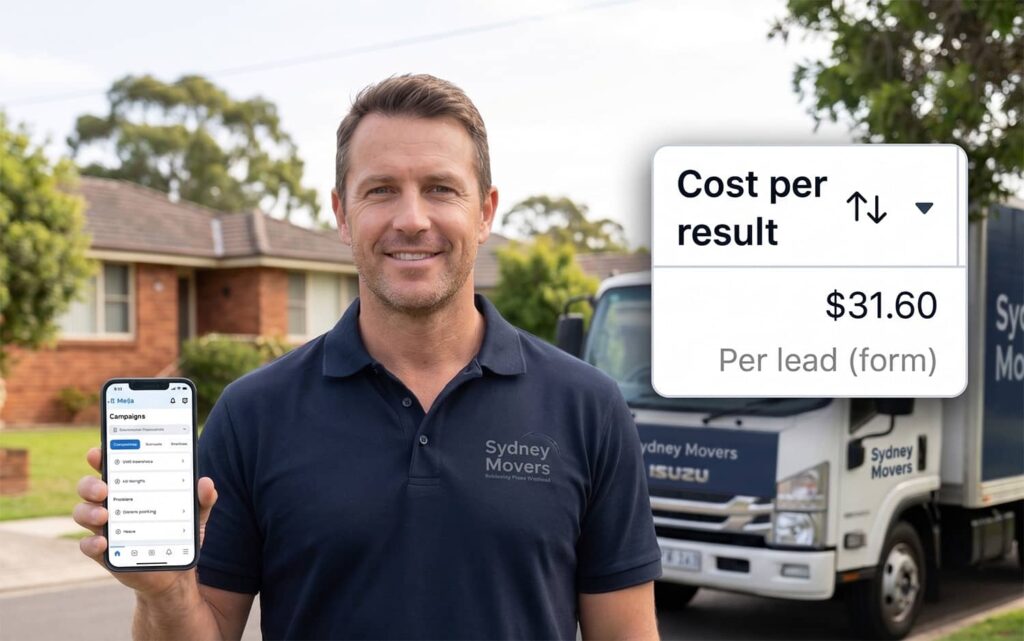
If the campaign is producing leads at a cost you’re comfortable with — typically anywhere from $20 to $50 per quote request for residential moves — start scaling. Increase the budget by 20 to 30% every three to four days. Aggressive jumps (doubling overnight) often spike the cost per lead temporarily because Meta has to re-optimise. Gradual scaling holds the cost per lead more stable.
When cost per lead starts climbing as you scale, that’s the signal you’ve reached the practical ceiling of your current audience and creative. Refresh the creative, broaden the targeting slightly, or accept that the channel has a natural budget cap for your service area.
According to WordStream’s 2025 Facebook Ads benchmarks, home services see average click-through rates around 1.2% and conversion rates on landing pages around 6-9%. If your numbers are wildly below those, the issue is usually creative or landing page, not the platform itself.
How Meta works alongside your other channels
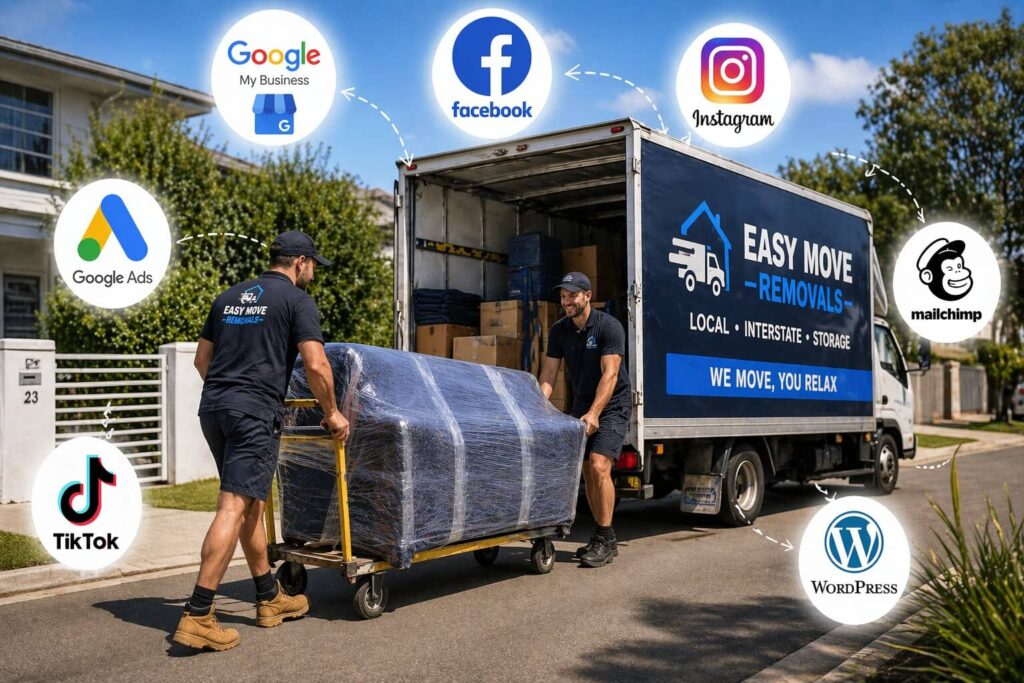
Meta works best as one channel in a stack, not the whole strategy. The handoffs between channels are where most of the real revenue is built.
Meta drives cold awareness, which feeds your retargeting pool, which converts. A new visitor sees a Facebook ad, clicks through to your site, doesn’t book, then sees your retargeting ad three days later with a customer testimonial, and books from there. The retargeting ad gets the credit, but Meta delivered the audience.
Meta also pairs unusually well with Google Ads. People who’ve seen your brand on Facebook are dramatically more likely to click your Google Ad when they later search for a removalist — because the name is already familiar. Our practical guide to Google Ads for removalists covers the search side of that combination.
For the offline pairing, Meta and direct mail target overlapping windows of the customer journey from different angles. A household that recently listed their property might see a direct mail piece on Tuesday and a retargeting ad on Friday, and book on Saturday — and the booking traces back to the direct mail, but the retargeting ad is what kept you front of mind. Our guide to direct mail for removalists covers the data and timing of that offline side.
And the long-term play underneath all of it is local SEO. Meta drives short-term lead flow, but strong local rankings build the free, compounding traffic that reduces your dependence on paid channels over time. The two work together — Meta funds growth this quarter, SEO funds growth two years from now.
For a side-by-side view of how Meta compares to the other channels on cost, time-to-result, and effort, our breakdown of the best digital marketing strategies for removalist businesses puts them on the same scoreboard.
The metrics that actually matter
Most removalists running Meta Ads check the wrong numbers. Likes, reach, and impressions feel meaningful but tell you almost nothing about whether the campaign is making money. Four metrics matter, and the rest are noise.
Cost per lead. Total spend divided by the number of quote requests or lead form submissions. This is the single most important number. Aim for somewhere between $20 and $50 for residential, $40 to $100 for commercial.
Lead-to-booking conversion rate. What percentage of leads from Meta actually book a job? This is where the channel often disappoints removalists who don’t measure it. A lead from Meta is colder than a lead from Google, so the conversion rate is usually lower — typically 15 to 25% versus 30 to 50% for Google Ads. Knowing this lets you compare channels honestly on cost per booking, not cost per lead.
Cost per booking. Total Meta spend divided by the number of jobs that came from it. This is the only number that matters commercially. A $30 lead that converts at 20% costs you $150 per booking. A $50 lead from Google that converts at 40% costs $125 per booking. Same spend, similar outcome — but you’d never know without tracking it through.
Average job value from Meta leads. Some channels deliver leads that book bigger jobs than others. If your Meta leads consistently book smaller residential moves while your referrals book full-house relocations, that changes how much you should spend on each. Our complete marketing guide covers the full picture of which metrics to track across every channel.
A weekly five-minute review of these four numbers is enough to keep Meta producing for you. Ignore them, and the platform quietly drifts toward expensive impressions and cheap likes.

When Meta doesn’t work (and what’s usually wrong)
Most removalists who say “Meta doesn’t work for us” have one of four problems, not a platform problem.
Slow follow-up. Meta leads go cold faster than any other channel. A lead form submission that gets a phone call within 5 minutes converts at roughly 4 times the rate of one called within 24 hours, according to research aggregated by Vendasta. If your team doesn’t have a system to respond fast, the channel will always look worse than it is.
Generic creative. Stock photo ads, “we are professional” headlines, and no real footage of your team will quietly suppress your reach. The fix is real video, real customers, and real before-and-after.
Targeting too broad. “All of Sydney, ages 18-65” is a cost-per-lead disaster. Tightening to a real service area with relevant life-event targeting often halves the cost per lead overnight.
No retargeting. Cold Meta traffic is expensive. Cold Meta traffic that’s never re-engaged is a complete waste, because most people who see your brand on Meta won’t book on the first interaction. Without retargeting, you’re paying for awareness you never cash in.
If the channel isn’t working, the platform isn’t usually the problem. The setup is.
When you’re ready to stop running it yourself
A well-run Meta Ads account for a removalist business takes about 3 to 5 hours a week to manage properly — testing creative, watching cost per lead, refreshing audiences, optimising landing pages. Most owner-operators do it themselves for the first six months while they learn the platform.
If you’d rather have someone build the campaigns, write the creative briefs, and manage the spend, our team at Apollo Digital runs Meta Ads for service businesses across Australia. Worth a look if you’d rather outsource than upskill.
If you want to know exactly what this channel typically costs, what a healthy cost per lead looks like, and how it compares to the alternatives, see our guide on removalist marketing costs and budgets.
The takeaway
Meta Ads aren’t a magic lead source, and they’re not a waste of money either. They’re a precision tool — strong when the targeting, creative, and follow-up are dialled in, weak when any one of those three is missing.
The system isn’t complicated. Start with a lead-gen campaign targeting your real service area with one strong life-event filter. Use real video creative. Install the Meta Pixel and set up retargeting from week one. Respond to every lead within five minutes. Track cost per booking, not cost per lead. Scale gradually once the numbers look right.
Run that system consistently for a quarter and Meta becomes one of the lowest cost-per-booking channels you have. Skip any of those pieces and it becomes the channel everyone blames the platform for. Same platform, completely different outcome.
For the broader marketing picture, see our complete guide to marketing your removalist business. For the platform that catches the customer at the search moment instead of the scroll moment, our practical guide to Google Ads for removalists is the next read. And to make sure the traffic Meta sends to your site actually converts, our removalist website conversion guide covers exactly what referred traffic is looking for.