

If trust is the single biggest factor in winning removalist work, reviews are the single biggest signal of trust. There’s a hard commercial reality behind that. People are about to hand you every item they own. They’ve never met you. The only thing standing between them and a stranger with a truck is what other strangers have said about the experience.
Get reviews right and your phone rings, your Google rankings climb, your ad costs drop, and your closing rate on quotes goes up. Get them wrong, or worse, ignore them entirely, and you’re invisible in a market where almost every booking starts with someone reading reviews.
This guide walks through how to build a review system that runs in the background of your business, how to handle the bad ones, and how to put the good ones to work everywhere they can earn you bookings.
This article is part of our broader complete guide to marketing your removalist business. Read that for the full marketing picture, or stay here for the deep-dive on reviews.
Why reviews matter more for removalists than almost any other industry
Most service businesses care about reviews. Removalists live or die by them. There are three reasons.
The first is the fear factor. A bad haircut grows back. A bad meal is forgotten by Tuesday. A bad removalist breaks a wedding photo and loses a tenancy bond. The customer’s downside risk feels enormous, so they over-research before they book. The BrightLocal Local Consumer Review Survey consistently finds that the higher the perceived risk of a service, the more reviews customers read before deciding.
The second is the comparison shop. Movers don’t book the first removalist they find. They almost always grab three to five quotes, and the deciding factor between similar prices is usually whichever business has the strongest, most recent review profile. You can be ten dollars more expensive than a competitor and still win, if your review wall does the work.
Reviews are a decision-stage signal above all else. They’re the piece of proof a shortlisted customer looks at last before they book. We’ve explained where reviews sit in the wider customer journey, and how they pair with awareness-stage channels like Meta and direct mail, in our guide on understanding your customer’s buying journey.
The third is Google’s algorithm. Reviews are one of the strongest “prominence” signals Google uses to rank local businesses, which means they don’t just convert visitors. They drive whether you even show up in the first place. Our local SEO guide for removalists has the full breakdown of how reviews feed into local rankings.
In short: reviews don’t just influence the booking decision. They influence whether the booking decision ever reaches you.
What Google actually looks at
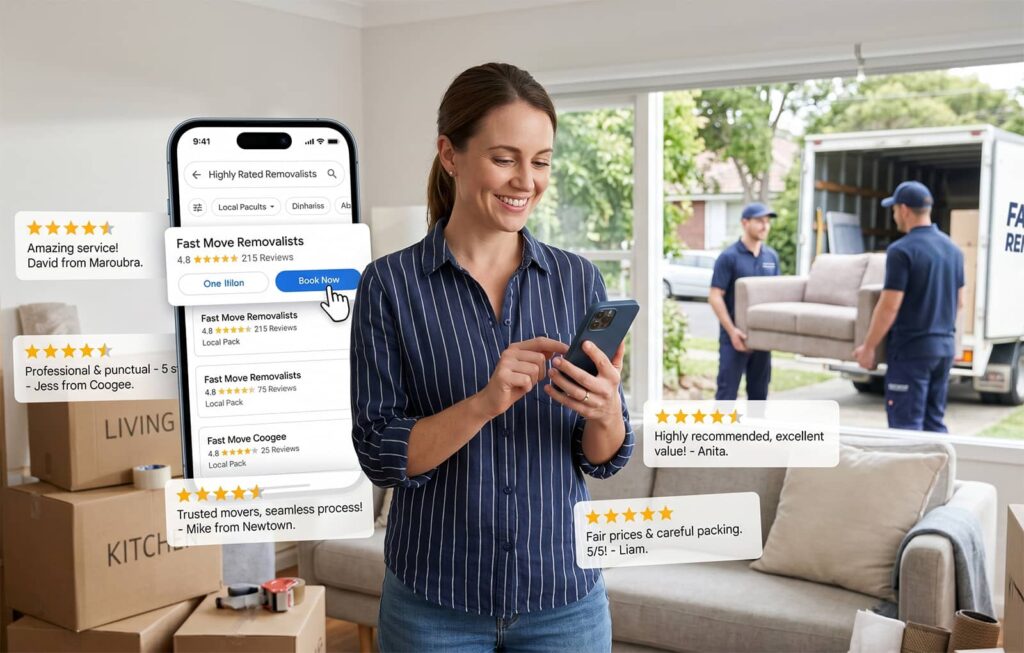
Owners often think “more reviews” is the goal. It’s part of it, but not the whole picture. Google’s local algorithm weighs five things on a review profile.
Volume is the obvious one. More reviews than your nearest competitor in the same suburb is the bar to aim for.
Average rating matters next. Anything below 4.0 stars is a serious problem and most movers will skip your listing entirely. Anything from 4.6 upwards is a serious advantage. The sweet spot for most strong service businesses sits between 4.7 and 4.9. A perfect 5.0 with hundreds of reviews can actually look fake to wary customers.
Recency matters more than most owners realise. A profile with 200 reviews from three years ago and nothing since signals a business that may not even be trading anymore. A steady drip of new reviews each month signals an active, healthy business. Aim for new reviews in your profile every week if possible.
Keyword content matters. When customers mention “removalist”, “moved my house”, “Sydney to Melbourne”, or specific suburbs in their reviews, those mentions reinforce your relevance for those searches. You can’t and shouldn’t dictate what customers write, but you can prompt them with a thank-you SMS that subtly reminds them of the move (“Thanks for choosing us for your move from Bondi to Manly…”), which often surfaces in their review.
Owner responses matter. Google rewards profiles where the owner replies to every review, positive or negative. The BrightLocal data is unusually clear here: 88% of consumers say they’d consider a business that responds to all reviews, while less than half would consider a business that ignores them.
If you’re optimising one thing, optimise the system that produces all five at once. That’s what the next section is about.
The simple system that produces reviews on autopilot
Most removalists ask for reviews ad hoc. The crew leader remembers some days and forgets others. Someone might send a thank-you message if they’re not too tired. The result is a trickle of reviews from a fraction of completed jobs.
A proper system fixes this without adding work to the day. Here’s what it looks like.
Step 1: a review link you can send in one tap. Use the Google review link generator inside your Google Business Profile to create a direct URL that opens straight to the review screen on your business. Save that URL into a phone shortcut, an email signature, your CRM, your invoice template, your job-management software, and a printed business card you leave with each customer.
Step 2: an SMS within an hour of the job ending. Set this as part of your standard operating procedure. The crew leader hits “send” the moment the truck leaves the new property. A typical message:
Hi Sarah, thanks again for choosing us today. Hope the new place feels like home soon. If we did a good job, we’d be really grateful for a quick Google review here: [link]. Have a great evening, the [Business Name] team.
The “within an hour” part matters. Customers are at peak gratitude in the first 60 to 120 minutes after their move ends. By the next morning, the boxes are looming and your message is forgotten.
Step 3: a follow-up email the next day. Not a chase, just a soft second touch. Something like:
Hi Sarah, just wanted to check in after yesterday’s move and make sure everything has settled in nicely. If you have a spare minute, your feedback on Google would mean a lot to a small business like ours: [link]. No pressure, and thanks again for the move.
Step 4: review request printed on every invoice and receipt. A small QR code at the bottom of every PDF invoice, with the line “If we did a good job, we’d love a review”. Reviews come in weeks later from people who finally got around to reconciling their move expenses.
Step 5: train crew leaders to ask in person. A short, genuine ask at the end of every job (“If you’re happy with the move, a Google review would really help us out”) roughly doubles the conversion rate of your SMS. People who say yes verbally are dramatically more likely to actually leave one.
A removalist running all five steps consistently captures Google reviews from somewhere between 15% and 30% of completed jobs. A removalist running none of them captures around 2% to 4%. Same business, same customers, ten times the review velocity.
When to ask matters more than how
The single biggest mistake removalists make with review requests is timing. Too early and the customer hasn’t unpacked enough to feel grateful. Too late and the moment has passed.
The window that consistently works best:
- The verbal ask at the moment the job is signed off and paid, while you’re still face-to-face.
- The SMS within 60 minutes of leaving the property.
- The email the next morning, between 8am and 11am.
- The invoice link is passive but always there.
Avoid asking before the job is finished. Avoid asking on a public holiday or a weekend evening. Avoid asking via social media DM, which feels intrusive.
How to respond to every review (positive and negative)
Responding to reviews is half the value of the review itself. It tells the customer you saw them, it tells future readers you’re paying attention, and it directly improves your Google ranking.
Positive reviews. Reply within 24 to 48 hours. Use the customer’s first name. Reference something specific to their move (“Glad the move from Northcote went smoothly, and hope the cat is settling into the new place”). Avoid templated replies that read as if you copied and pasted them. Future readers will scroll your responses, and a wall of identical “Thank you for the kind words!” replies looks worse than a wall of unique, specific ones.
Negative reviews. This is where most owners go wrong. The instinct is to defend, explain, or argue. The right move is the opposite.
A good response to a negative review does four things:
- Thanks the customer for the feedback (genuinely, not sarcastically).
- Acknowledges their experience without admitting fault you don’t actually owe.
- Offers to make it right by phone or email, away from the public review thread.
- Stays calm and professional, no matter how unfair the review reads.
A template that works:
Hi James, thanks for taking the time to share this. I’m sorry the move didn’t meet your expectations and I’d really like the chance to understand what happened and put it right. Could you call our office on [number] when you get a moment? We take this seriously and want to learn from it. [Owner first name].
What you must never do: argue, mock, name-drop the customer’s mistakes, or post your side of the story in detail. Future readers don’t read a defensive response and side with the business. They read it and side with the customer.
The Australian Competition and Consumer Commission (ACCC) publishes plain-English guidance on managing online reviews, including what businesses can and can’t legally do. Worth a read once.
What to do about a clearly fake or defamatory review
Some negative reviews are not from real customers. Competitors, ex-employees, scammers asking for refunds-for-removal, all of these turn up over time. Google has a formal review removal process you can use to flag reviews that violate their content policies, including:
- Reviews from someone who was never a customer.
- Reviews that contain slurs, threats, or personal attacks.
- Reviews posted by competitors, employees, or anyone with a conflict of interest.
- Reviews that are off-topic or unrelated to the actual service.
The process isn’t fast and Google’s review team isn’t generous, but legitimate removal requests succeed often enough to be worth the effort. Document everything: dates of jobs, customer records, screenshots of the review in question. If the review is clearly defamatory under Australian law, the Office of the Australian Information Commissioner (OAIC) and a defamation lawyer are the next steps, but those should be a genuine last resort.
How to put your reviews to work everywhere
Reviews aren’t just for your Google Business Profile. Every review you capture is a marketing asset you can repurpose across your channels. The under-used ways to do this:
On your website. A live Google Reviews feed on your homepage, your service pages, and especially your suburb pages, beats hand-picked testimonials every time. Visitors trust reviews they know you can’t filter. Our removalist website conversion guide covers exactly how this drives bookings.
In your Google Ads. Google Ads can pull your average rating into the ad itself if you have at least 100 reviews and a 3.5+ rating. The visible star rating typically lifts click-through rates by 10% to 17%. Setup details are in our practical guide to Google Ads for removalists.
The same logic applies to Meta. A retargeting ad on Facebook or Instagram that leads with social proof — ‘Over 400 five-star Google reviews’ — typically halves the cost per lead of a generic ‘get a quote today’ creative. Our practical guide to Meta Ads for removalists covers how reviews shape ad performance across cold and warm audiences.
In your direct mail. A short trust line on a mailer (“Over 1,200 five-star Google reviews. Family-owned. Fully insured.”) is one of the highest-converting elements you can include. This pairs especially well with data-driven direct mail through Move First, where you’re reaching homeowners the moment they list their property and they’re about to start comparing removalists.
In your social posts. Once a week, share a recent five-star review as a Facebook or Instagram post. Tag the customer (with permission) and add a one-line owner thank-you. Builds a steady drumbeat of social proof without you having to write content.
In your sales follow-ups. When a customer asks for a quote and goes quiet, a friendly “happy to share a few recent reviews from similar moves” email re-engages a meaningful share of cold leads.
A review that lives only on Google does maybe 30% of the work it could be doing. A review used everywhere does the rest.
Tracking review velocity over time
The metric most removalists never track but should: review velocity. Specifically, how many new reviews you collect per month, and how that trends over the year.
A simple monthly check:
- New reviews this month vs last month vs the same month a year ago.
- Average star rating over the last 30 days vs lifetime.
- Number of reviews mentioning specific suburbs you want to rank for.
- Number of reviews you’ve responded to in the last 30 days (target: 100%).
Five minutes once a month, in a spreadsheet or note. That’s all the tracking you need to spot a slowdown, a quality issue, or a competitor pulling ahead before it costs you bookings.
When you’re ready to stop running it yourself
A solid review system runs in the background of your business once it’s set up. Most removalist owners can manage it with maybe 15 minutes of attention a week, mostly responding to new reviews.
If you’d rather have someone build the templates, install the tracking, write the responses, and chase the slow customers in your CRM, our sister agency Apollo Digital runs review and reputation management for service businesses across Australia. Worth a look if you’d rather outsource than upskill.
The takeaway
Reviews are the highest-leverage marketing asset a removalist business can build, and the cheapest. The system that produces them is not complicated. A review link, an SMS, a follow-up email, an invoice prompt, and a verbal ask at the end of every job. Run consistently, that system delivers a steady drumbeat of new reviews that compounds your rankings, your conversion rate, and the trust you earn before a customer ever picks up the phone.
Start the system this week. By next quarter, you’ll be the removalist with the strongest review wall in your service area, and that’s the wall every booking decision is built on.
For the broader marketing picture, see our complete guide to marketing your removalist business. For how reviews fit into local rankings, our local SEO guide for removalists has the deeper detail. And for how to display reviews in a way that actually drives bookings, our removalist website conversion guide walks through it.