
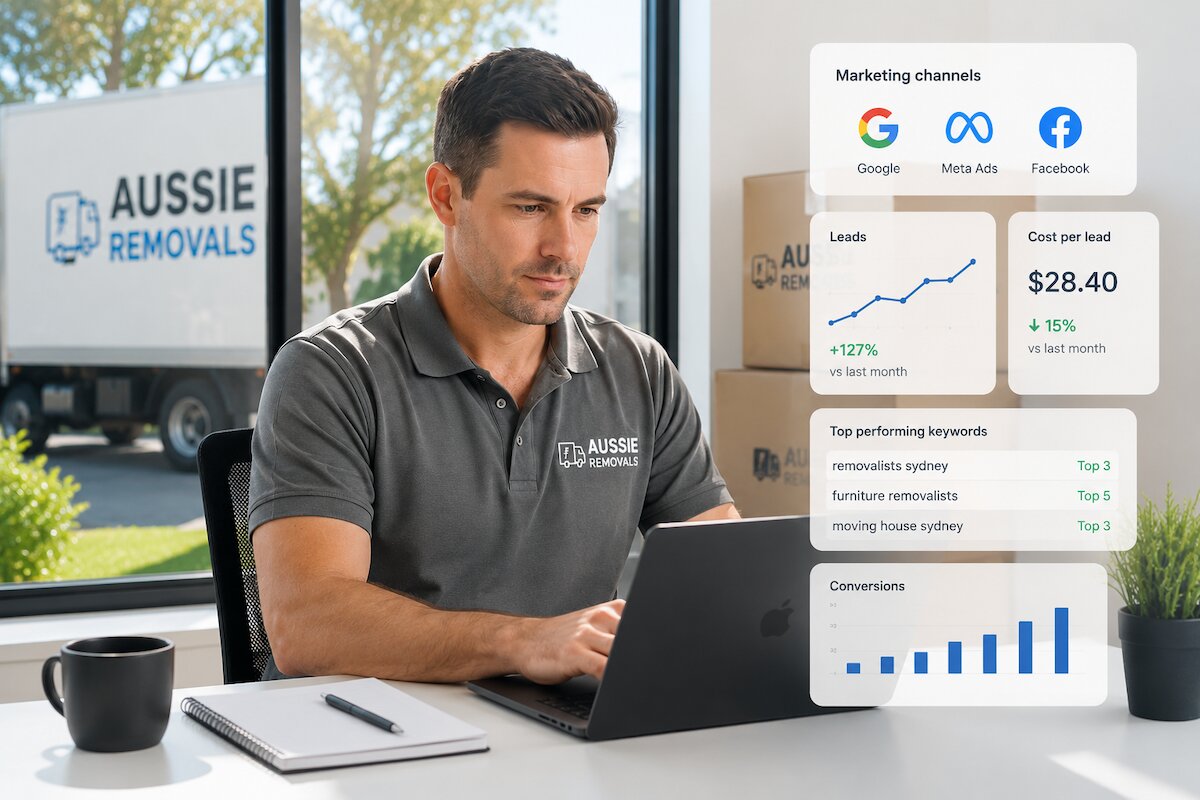
Hiring a marketing agency is one of the highest-stakes decisions a removalist owner makes. Get it right and you’ll spend the next few years focusing on running the trucks while a professional team fills your calendar. Get it wrong and you’ll spend $30,000 to $60,000 a year on retainers that produce nothing measurable, tied up in a 12-month contract you can’t get out of.
This guide walks through how to actually evaluate a marketing agency before you sign anything. What to look for. What to avoid. What questions to ask. How the pricing works. And how to know within the first 90 days whether the agency you’ve hired is going to earn its keep.
It’s written for removalist owners who want a straight answer, not a sales pitch. If you’d rather do the marketing yourself, our complete guide to marketing your removalist business walks through every channel in detail. If you’ve decided you want an agency and just want to know how to pick a good one, keep reading.
What you can genuinely do yourself vs what needs a professional
Let’s be honest about this upfront, because a lot of marketing advice pretends it’s easier than it is.
There are exactly two parts of removalist marketing that a business owner can realistically run themselves without producing bad results:
Organic community engagement.
Being active in local Facebook community groups, answering moving questions helpfully, occasionally posting a job story or seasonal reminder, showing up as a real person in the areas you serve. This costs nothing, doesn’t require technical skill, and genuinely works for local awareness. If you enjoy it, keep doing it.
Asking for reviews and responding to them.
Building a simple SMS follow-up habit, printing a review link on invoices, and personally replying to every review that comes in. Our Google reviews for removalists guide walks through the exact system.
That’s the honest list. Everything else in digital marketing (Google Ads, Meta Ads, local SEO, Google Business Profile optimisation, website conversion, tracking setup, retargeting, landing page design) is specialist work that takes years to get good at and produces measurably bad results when handled by someone learning as they go.
The reasons it isn’t a fair fight:
- Google Ads has a steep learning curve and an expensive tuition fee. Businesses running their own ads without experience typically spend two to three times more per lead than a well-managed account, sometimes for months before they realise what’s happening. WordStream’s benchmark data on service-industry ad accounts consistently shows this gap.
- Local SEO requires an understanding of schema markup, NAP consistency across dozens of directories, backlink profiles, and Google’s local ranking factors. Doing it wrong doesn’t just underperform, it can actively damage your rankings.
- Meta Ads depend on pixel setup, audience segmentation, and creative testing frameworks that are genuinely technical.
- Websites need to load fast on mobile, convert visitors, track events, and stay secure. Most owner-built or budget sites fail at least three of those.
- Tracking and attribution across channels is its own discipline. Without it, you can’t tell what’s working.
The scenarios where hiring an agency clearly makes commercial sense are broader than most owners realise. If you’re spending more than a couple of hundred dollars a month on paid channels, you’re better off with a professional running them. If you have a website and no clear plan for improving it, you’re leaving bookings on the table. If your Google Business Profile is anything less than fully optimised, an agency will pay for itself in months just from unlocking that one asset.
The question, in most cases, isn’t whether to hire an agency. It’s when and which one.
If you’d like the wider view on what a full marketing plan covers so you know what a good agency should be doing for you, our best digital marketing strategies for removalist businesses guide is a solid overview.

What the right agency actually does for a removalist
A strong agency doesn’t do one thing. It runs a coordinated set of channels aimed at the same commercial outcome, which is booked jobs at an acceptable cost per booking.
For a removalist business, the work usually looks like this:
- Google Ads.
Setup, keyword research, ad copy, landing pages, negative keyword lists, conversion tracking, ongoing optimisation. Deep detail on what this looks like when done well is in our practical guide to Google Ads for removalists. - Meta Ads.
Retargeting, life-event audiences, ad creative aimed at the pre-search stage of the customer journey. Our Meta ads for removalists guide covers the tactical setup. - Local SEO.
Google Business Profile management, suburb pages, review acquisition systems, local backlink building. Our local SEO for removalists guide has the full playbook. - Website.
Conversion optimisation, page speed, lead form design, tracking setup. Our removalist website conversion guide covers what a converting site actually looks like. - Reviews and reputation.
A system for capturing, responding to, and displaying reviews across every channel. Our Google reviews for removalists guide walks through the system. - Measurement and reporting.
Monthly reporting on cost per lead, quote-to-booking rate, source attribution, and return on ad spend, in a format you can actually understand.
An agency that only offers one of these (say, just Google Ads) is a specialist. That can be a fit for a specific problem, but it isn’t a full marketing partner. A full-service agency should cover the mix and coordinate the messaging across channels so that each one is speaking to a different stage of the customer’s buying journey.
Red flags to walk away from
Some behaviours are consistent warning signs regardless of the agency’s promises. If you see any of these in the sales process, take it seriously.
Guaranteed rankings or leads.
Nobody can guarantee first-page Google rankings. Google’s own webmaster guidelines explicitly warn against agencies that make this promise. Anyone who does is either misleading you or planning to run black-hat tactics that will eventually get your site penalised.
Pressure to sign quickly.
“This price is only available if you sign this week.” A serious agency doesn’t need to pressure you. This kind of tactic almost always signals that the deal gets worse the longer you look at it.
Vague or non-existent reporting.
If they can’t clearly explain how they’ll measure success in month one, they don’t have a plan. Ask to see a sample monthly report from an existing client before signing.
Long lock-in contracts with no exit clause.
12-month contracts are common. 12-month contracts with no performance clause and no way out are not. The Australian Competition and Consumer Commission (ACCC) publishes plain-English guidance on unfair contract terms that’s worth reading before you sign.
No case studies from similar businesses.
If they’ve never worked with a removalist or a comparable service business (plumbers, electricians, home services), that’s not automatically disqualifying, but they should be able to show equivalent results in a similar industry. Ask for two or three references you can call.
A hard focus on “brand” over measurable results.
For a service business your size, brand awareness is a byproduct of running the right channels, not the goal itself. If the agency’s pitch is heavy on brand strategy and light on leads generated, they’re probably better suited to a much bigger client than a removalist business.
Ownership of your accounts.
Some agencies set up your Google Ads, Google Business Profile, or website under their own account and refuse to hand it over when the relationship ends. You should own every account they set up. It should be in the contract.

Questions to ask before you sign anything
A short, disciplined list. Ask every candidate agency the same questions and compare the answers side by side.
- What’s your process for the first 90 days?
A good agency has a clear answer: audit, foundation fixes, initial campaign launches, first measurement cycle. - Which channels will you run, and why?
They should tie their channel choice to a stage of your customer’s journey. If that’s a new lens, our customer buying journey guide for removalists explains the framework. - What are the cost-per-lead and cost-per-booking benchmarks you aim for?
They should give you a specific range for your market, not “it depends”. - How much of the work is done in-house vs offshored?
Not automatically a dealbreaker if offshored, but you should know. - Who is my day-to-day account manager, and how experienced are they?
Sales calls are often taken by the agency’s best senior person. The actual work is often done by junior staff. Ask who you’ll actually deal with. - What’s the reporting cadence and format?
Weekly, monthly, or quarterly. Written report, dashboard, or call. Get an example of what you’ll receive. - What happens if we’re not seeing results by month three?
A serious agency will have a clear answer. A weak one will hedge. - What are the exit terms?
Notice period, cost to leave, ownership of accounts and creative assets. - Can I speak to two or three current clients?
If they refuse, that’s a red flag on its own.
Take notes. Compare answers. Trust the pattern more than any single line.
Pricing models explained
There are three common ways marketing agencies charge, and the right one depends on your goals.
Monthly retainer.
The most common model. A fixed monthly fee, usually between $2,000 and $10,000+ for a small to mid-size service business. The agency does an agreed scope of work each month. Best when you want predictable spend and a long-term partnership.
Project fee.
A one-off cost for a defined piece of work, like a website rebuild, a local SEO setup, or a Google Ads audit. Usually between $3,000 and $25,000 depending on scope. Best when you have a specific problem to solve and don’t yet want ongoing management.
Performance-based.
The agency charges based on leads or bookings generated. Sounds attractive but rarely works out well in practice. The agency’s incentive is short-term lead volume, not long-term brand or SEO investment. It also incentivises them to send junk leads and count them as wins. Better avoided for a service business your size.
Whichever model you pick, ad spend is almost always separate from agency fees. If they quote you $3,000 a month and don’t specify, ask whether that includes your Google and Meta ad spend or sits on top of it. That $3,000 can quickly become $6,000+ once ad budget is added.
The sweet spot is an agency that combines both. Enough removalist or Industry experience matters, but so does breadth
Specialisation cuts both ways, and this is one of the least-discussed trade-offs in the agency hiring decision.
The upside of hiring a specialist is real. An agency that has worked with removalists before doesn’t need to figure out which keywords convert. They already have benchmark cost-per-lead numbers to measure your account against. They understand the seasonality (end of month, EOFY, Christmas rush). They know how a residential mover thinks compared to a commercial client. That head start comes out of your ad budget when you hire an agency that has never touched the industry before.
The downside of hiring a pure-play removalist specialist is less obvious but just as real. Agencies that only work in one industry tend to slip into rinse-and-repeat thinking. They apply the same template to every client because it worked for the last one. They stop asking why. They miss ideas that are obvious in adjacent industries but haven’t yet crossed over into their playbook.
Agencies that work across a spread of industries usually develop stronger craft. They see a conversion tactic that works in home services and bring it to trades. They see a landing page structure that outperforms in professional services and test it in retail. They apply consumer psychology from one category to a completely different one, and often find it works even better. That cross-pollination is a genuine advantage they bring to your business, and it’s the reason a lot of the best marketing thinking sits with generalists rather than pure specialists.
The sweet spot is an agency that combines both. Enough removalist or service-business experience that they aren’t learning on your budget, and enough breadth across other industries that they bring fresh thinking rather than the same template every previous client got.
When you’re evaluating candidates, ask two questions:
- How many removalist or service business clients have you worked with? You want real experience, not zero.
- What have you learned from working in other industries that you’ve applied to service businesses like ours? A strong answer separates a curious, sharp agency from a template shop.
If they only talk about their removalist work, be cautious. If they can talk about ideas pulled from retail, hospitality, professional services, or consumer, and how they’ve applied them to service businesses, you’ve found the more interesting operator.
If you’d rather skip the search entirely, our sister brand Apollo Digital is a marketing agency for removalists with extensive experience in the industry, and they also work across a spread of other service-based businesses in Australia. That combination (deep removalist knowledge plus cross-industry breadth) is exactly the sweet spot described above. They aren’t learning the industry on your budget, and they aren’t running the same tired template on every client either. Transparent pricing, no lock-in traps, monthly reporting in plain language. Worth a look.

How to know within 90 days whether it’s working
Signing an agency is not “set and forget”. The first 90 days is the window in which you decide whether to keep going or cut ties.
The three checkpoints:
Month 1: setup and foundation.
By the end of month one, you should see the audit results, agreed campaign structures, tracking installed, and initial baseline reporting. If they’ve spent the whole month “getting to know your business” and haven’t shipped anything, that’s a bad sign.
Month 2: launch and early data.
Campaigns are live. You should be seeing leads coming in, tracked correctly to the source, with a first read on cost per lead. Numbers won’t be optimised yet but you should see activity.
Month 3: optimisation and results.
By the end of month three, you should be seeing cost per lead moving in the right direction and a clear plan for how it improves further. If cost per lead is still at “we’re figuring it out” levels, ask hard questions.
The five metrics to track from day one:
- Cost per lead by channel.
- Quote-to-booking conversion rate.
- Customer acquisition cost (total spend divided by new customers).
- Source of every enquiry so you can attribute wins to channels.
- Return on ad spend for each paid campaign.
Any agency worth their fee will report on these clearly every month. If yours doesn’t, the problem is either the agency or the reporting, and both need fixing.
A quick note on doing it yourself instead
An agency isn’t the only path. If you have the time, some technical comfort, and a smaller budget, you can build a serviceable marketing operation yourself using free resources.
Our complete guide to marketing your removalist business covers every channel in detail. Our channel-specific guides (Google Ads, Meta Ads, Local SEO, Google Business Profile, Reviews, Website Conversion, Direct Mail) go deeper into each one. Combined, they cover roughly 80% of what a mid-size agency would do for you, minus the ongoing management time.
The trade-off is your hours. If your time is better spent running the business, an agency wins. If you have the hours and want to keep the retainer money, doing it yourself is realistic.

Where Move First fits alongside an agency
One more thing worth flagging. Whether you hire an agency or run marketing yourself, Move First is a specific product that most agencies don’t offer natively. It uses public property listing data to identify homeowners who have just listed their property for sale, and automatically sends them a personalised letter to your specifications, so you reach them before they’ve searched for a removalist. It sits alongside whatever paid, SEO, or social work an agency is doing, and it fills the one gap agencies typically can’t fill: reaching customers in the pre-search stage of the buying journey.
If you’re evaluating agencies, ask whether they’ll integrate a data-driven direct mail channel like Move First into the plan. A good agency will say yes and welcome it. A weak one will discourage anything outside their standard toolkit.
The takeaway
Choosing a marketing agency for a removalist business comes down to a small number of things done properly.
Match the agency to your stage. Don’t hire one before you’ve hit the growth ceiling that justifies it. Look for industry specialisation, transparent pricing, clear reporting, and reasonable exit terms. Walk away from guarantees, pressure tactics, and long lock-ins with no performance clause. Set clear 90-day checkpoints so you know within a quarter whether to double down or move on.
Ask the same set of questions to every candidate. Compare answers side by side. Trust the pattern more than the sales pitch.
If you’d rather short-cut the search and work with an agency built specifically for this industry, our sister brand Apollo Digital is a marketing agency for removalists based in Australia. And if you’d rather do it yourself, our complete marketing guide for removalists covers every channel step by step.
Either path can work. What matters is that you pick one deliberately and measure it honestly.